Cybersecurity Awareness
Clear, everyday lessons on recognizing phishing and impersonation, storing credentials in password managers or passkeys, handling unexpected MFA prompts, and reporting suspicious messages before they spread.

Practical online courses covering phishing and wire-fraud defense, safe workplace AI habits, and everyday Microsoft and Google tools. Organizations and nonprofits nationwide can enroll staff for $50 per person per year, with no seat minimums and exportable completion logs for audits and cyber insurance.
Many security awareness vendors hide simple training behind 50-seat minimums, sales calls, and multi-year auto-renewals. That leaves smaller firms stuck between overpaying for unused seats or skipping structured training altogether. We publish one flat rate: $50 per person per year, so 20 employees cost $1,000 annually.
Each seat includes a 28-minute core cybersecurity course, a 16-minute AI cybersecurity module, ChatGPT and Microsoft Copilot fundamentals, Microsoft Office and Google Workspace lessons, and brief refreshers spaced across the year.
Ask about staff enrollment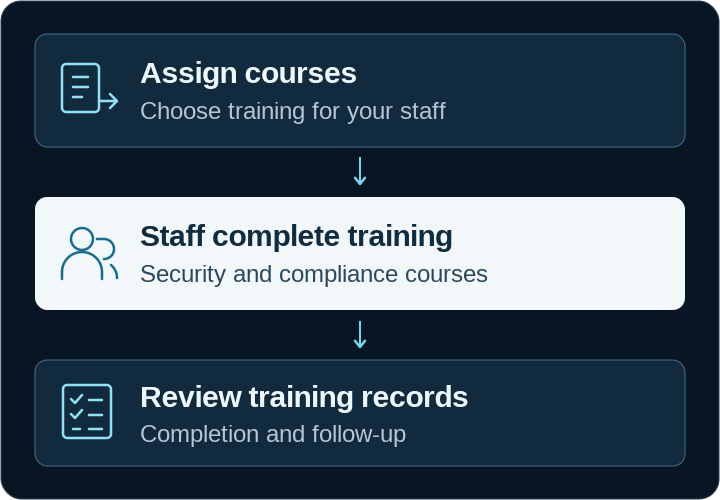
Clear, everyday lessons on recognizing phishing and impersonation, storing credentials in password managers or passkeys, handling unexpected MFA prompts, and reporting suspicious messages before they spread.
Employees already use AI tools whether policy mentions them or not. These modules explain why patient notes, card numbers, legal drafts, financials, source code, and API keys never belong in public prompts, how enterprise zero-retention tenants differ from consumer chatbots, and how to pair training with our AI Acceptable Use Policy template.
Included courses for Word, Excel, PowerPoint, Outlook, and Teams sit right alongside Microsoft 365 and Google Workspace security modules, giving new hires and longtime staff practical utility from the same portal.
Warning staff about misspelled spam emails stopped being enough years ago. Today an employee clicks what looks like an ordinary Microsoft 365 login prompt—except a reverse-proxy page sits in the middle waiting to steal the active session cookie right after MFA succeeds. Or a real vendor email thread gets hijacked days before an ACH payment, complete with an updated routing PDF.
How do you prepare people for traps like those without turning training into an annual chore nobody remembers by March? Short, specific refreshers spaced throughout the year stick far better than one long video once a year. Where finance, legal, clinical, or executive staff handle sensitive approvals, optional phishing and business email compromise (BEC) simulations can reinforce those habits as well.

Finance and operations staff see how hijacked vendor threads, lookalike sender domains, altered PDF invoices, and AI-cloned voice urgency work in practice, and why an out-of-band phone call comes before changing bank details.
Staff learn what happens when an unapproved meeting recorder joins a client call, a browser extension asks to read page data, or a rogue OAuth screen requests full mailbox and drive access.
Practical habits against MFA push-bombing, fake single sign-on portals, passwords kept in shared spreadsheets, and unmanaged personal laptops signing into company cloud accounts.
Auditors, cyber-liability underwriters, and enterprise customer reviewers ask for timestamped enrollment and completion logs rather than verbal assurances. Workforce training supplies that record alongside your technical and administrative controls.
| Framework | Control reference | Records supported |
|---|---|---|
| PCI DSS v4.0.1 | Req 12.6.1, 12.6.2 & 12.6.3.1 |
Onboarding and annual security awareness completion rosters, phishing and social-engineering lessons, and annual program review exports for QSA sampling. |
| SOC 2 (Type I & Type II) | CC1.4 & CC2.2 |
Timestamped new-hire completion within your onboarding window, annual active-workforce completion exports, and AI acceptable-use training logs. |
| HIPAA Security Rule | 45 CFR § 164.308(a)(5) |
Workforce security awareness and periodic reminders covering ePHI protection, ransomware defense, login hygiene, and keeping patient notes out of public AI tools. |
| CMMC 2.0 / NIST SP 800-171 | AT.L2-3.2.1, 3.2.2 & 3.2.3 |
Role-based security awareness, insider-threat and social-engineering modules, and exportable user-level completion records for assessment packages. |
Yes. Any business, healthcare practice, law firm, financial firm, or nonprofit across the United States can purchase standalone training seats at $50 per person per year without moving IT support to briskData. If you already use briskData Managed IT, we can align enrollment directly with your existing plan.
Yes. The library includes a 16-minute AI Cybersecurity course, AI Fundamentals, practical safe workflows for ChatGPT and Microsoft Copilot, short lessons on deepfake voice and video scams and rogue browser extensions, and leadership courses on managing staff AI adoption. Software subscriptions for ChatGPT or Copilot are separate.
The $50 per person annual rate covers full access to the online course library, AI security modules, year-round refreshers, and administrator completion tracking. Optional managed phishing and wire-fraud simulations, mail allowlisting, or turnkey compliance administration are quoted separately if you want them. See our pricing page.
Roster import and course assignment usually take one to two business days once you share your staff list. That gives employees straightforward time to finish core modules and export CSV or PDF completion records ahead of an assessment or cyber-insurance deadline.
Share roughly how many seats you need and whether you are looking for standalone $50/person/year course enrollment, phishing simulations, or audit completion logs for PCI DSS, SOC 2, HIPAA, or CMMC.
Available nationwide as a standalone subscription or alongside briskData Managed IT and security programs.
A 30-minute conversation with an engineer about what you need and next steps.
Times shown in Eastern Time
Available dates will appear here.
No time that works?